
Why Most Breakthrough Discoveries Never Become Products?

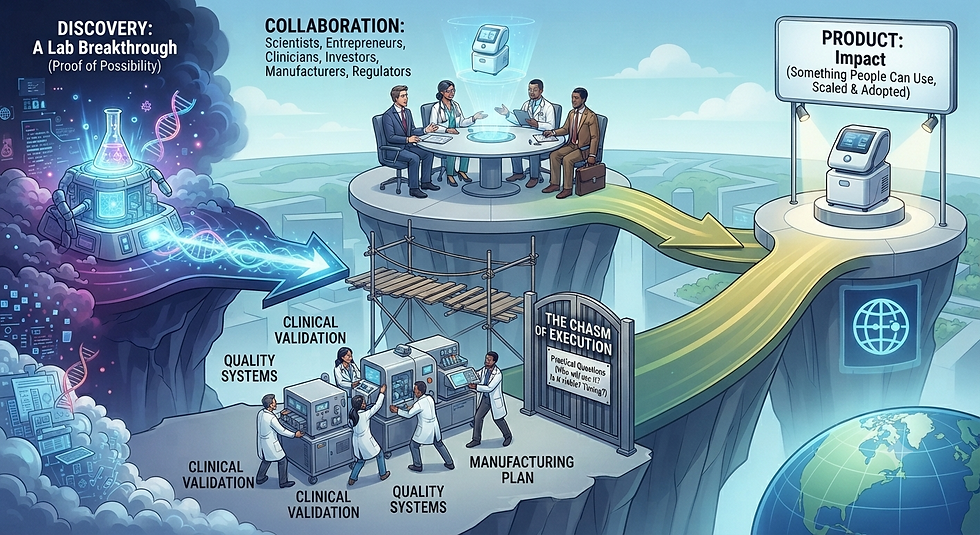
Every year, researchers publish discoveries with the potential to transform medicine, engineering, and technology. But only a small percentage ever become products that reach the market.
The reason is not usually poor science. More often, the problem is the gap between discovery and execution. A breakthrough in the laboratory proves that something is possible. It does not prove that it can be manufactured, regulated, adopted, or delivered at scale. Product development requires a completely different set of capabilities, including engineering, quality systems, clinical validation, intellectual property, financing, and market strategy.
Many research teams also delay asking practical questions. Who will use this technology? Does it solve a pressing problem? Can it compete with existing solutions? Without early answers, even outstanding discoveries can struggle to find a commercial path. Another challenge is timing. Scientific projects often advance faster than supporting infrastructure, reimbursement systems, or regulatory frameworks. A technology can be technically ready while the market is not.
Successful commercialization depends on collaboration. Scientists, entrepreneurs, engineers, clinicians, investors, manufacturers, and regulators all play different roles in transforming an idea into a product. No single group can complete the journey alone.
The discoveries that change industries are rarely those with the strongest data alone. They are the ones supported by a clear strategy for validation, translation, and execution. Innovation begins with discovery. Impact begins when discovery becomes something people can use.
If you would like to access a comprehensive analysis report on the topic of "AASE | Global Scientist Entrepreneurship," please visit my Pro Substack page (https://substack.com/@jackhuang2026).


Comments