
From Paper to Product: How Scientists Clear the First Hurdle in Biotech Entrepreneurship
- aaseusa
- Apr 30
- 6 min read
Abstract
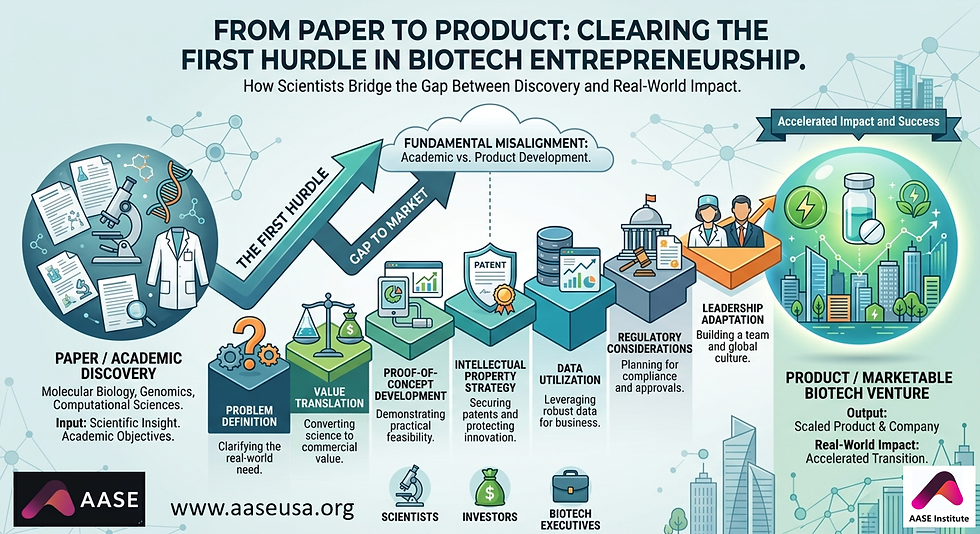
The translation of scientific discoveries into marketable biotechnology products remains one of the most challenging phases in the innovation pipeline. Despite significant advances in molecular biology, genomics, and computational sciences, a large proportion of academic findings fail to reach practical application. This gap, often described as the “first hurdle,” reflects a fundamental misalignment between the objectives of academic research and the requirements of product development. This article examines the key processes involved in transforming scientific knowledge into viable biotechnology ventures. It focuses on problem definition, value translation, proof-of-concept development, intellectual property strategy, data utilization, regulatory considerations, and leadership adaptation. By analyzing these components within a unified framework, this review provides insights relevant to scientists, investors, and biotechnology executives seeking to accelerate the transition from discovery to impact.
Keywords:
Biotech Entrepreneurship; Technology Translation; Product Development; Scientific Innovation; Intellectual Property; Proof of Concept; Regulatory Strategy; Data-Driven Biotech
Introduction
Biotechnology innovation is driven by discoveries that originate in academic laboratories. These discoveries frequently contribute to scientific knowledge but do not necessarily translate into usable products. The transition from publication to commercialization requires a shift in both perspective and methodology. While academic research emphasizes novelty, rigor, and reproducibility, product development demands applicability, scalability, and market relevance. The failure to bridge this gap has significant implications. Promising therapeutic targets, diagnostic approaches, and enabling technologies often remain underutilized, despite substantial investment in research. The underlying issue is not a lack of scientific quality, but rather the absence of structured pathways that connect discovery to application. Scientists entering entrepreneurship must therefore navigate a complex landscape that includes technical validation, intellectual property protection, regulatory compliance, and market alignment.
This article explores how scientists overcome the initial barrier in biotechnology entrepreneurship. It examines the transformation of scientific problems into product-oriented challenges and outlines the strategic steps required to establish a viable foundation for commercialization.
1. Reframing Scientific Questions into Product-Oriented Problems
The first step in commercialization involves redefining the purpose of the research. Scientific investigations are typically designed to answer specific questions within a defined field. However, product development requires identifying a problem that can be addressed in a practical context. This transition involves translating abstract findings into functional outcomes. For example, a study identifying a novel protein interaction may be scientifically significant, but its commercial relevance depends on whether it can be linked to a disease mechanism or therapeutic intervention. The ability to articulate this connection determines whether the discovery can progress beyond the laboratory. This reframing process requires engagement with stakeholders outside academia. Clinicians, industry professionals, and end users provide perspectives that help define the problem in actionable terms. Without this alignment, even highly innovative research may lack a clear path to application.
2. Establishing Value Through Problem Definition
In biotechnology, value is determined by the extent to which a product addresses a specific need. Unlike academic metrics, which prioritize originality and impact within a field, commercial success depends on usability and demand. Defining the target user is therefore essential. Different stakeholders evaluate value differently. Healthcare providers may prioritize diagnostic accuracy and speed, while pharmaceutical companies focus on predictive capabilities and development efficiency. Regulatory bodies emphasize safety and consistency. A successful product concept integrates these considerations into a coherent value proposition. This stage often reveals the need to refine or redirect the original research focus. By aligning the scientific insight with a defined application, researchers can establish a foundation for subsequent development.
3. Simplification and Functional Reduction
Scientific discoveries are inherently complex, often involving multiple variables and interactions. Product development requires reducing this complexity to a manageable and functional form. This process does not diminish the scientific contribution but rather concentrates it into a usable format. For instance, a comprehensive multi-omics dataset may provide extensive biological insights. However, a clinical product derived from this dataset may rely on a limited number of validated biomarkers. This reduction enhances reliability and facilitates adoption in real-world settings. The challenge lies in preserving the integrity of the underlying science while ensuring that the product remains practical. Achieving this balance is critical for successful translation.
4. Proof of Concept and Technical Validation
Proof of concept represents a key milestone in the transition from discovery to product. In academic research, validation is often demonstrated through controlled experiments and statistical analysis. In a commercial context, additional criteria must be addressed. These include reproducibility across different environments, scalability of the process, and compatibility with existing systems. Early-stage prototypes should be designed to test these parameters. Identifying limitations at this stage allows for iterative refinement and reduces the risk of failure in later phases. Proof of concept also serves as an important signal to investors and partners. It demonstrates that the technology has progressed beyond theoretical feasibility and is capable of practical implementation.
5. Intellectual Property as a Strategic Asset
Intellectual property (IP) plays a central role in biotechnology entrepreneurship. While publication establishes academic precedence, it may compromise the ability to secure patent protection if disclosed prematurely. Filing patents before public dissemination ensures that the innovation can be protected and developed within a defined framework. A robust IP strategy extends beyond a single patent. It may include a portfolio covering different aspects of the technology, such as composition, method, and application. This approach strengthens the competitive position of the startup and enhances its attractiveness to investors. Coordination with technology transfer offices is essential during this process. These institutions provide guidance on patentability, ownership, and licensing arrangements. Effective management of IP lays the groundwork for long-term value creation.
6. Data Integration and Asset Development
The role of data in biotechnology has expanded significantly in recent years. High-throughput technologies generate large volumes of information, which can be leveraged as a core asset. Data-driven approaches enable the identification of patterns and relationships that may not be evident through traditional methods. For scientists transitioning to entrepreneurship, this requires a shift in how data is perceived and utilized. Data must be curated, standardized, and integrated to support decision-making and product development. Proprietary datasets, particularly those linked to clinical outcomes, provide a competitive advantage. In many cases, the value of a biotechnology company is closely tied to its data infrastructure. Investments in data quality and management therefore have long-term implications.
7. Regulatory Considerations and Development Pathways
Regulatory frameworks influence every stage of biotechnology product development. Requirements vary depending on the type of product, such as diagnostics, therapeutics, or research tools. Understanding these requirements early in the process helps guide design decisions. For example, a diagnostic assay intended for clinical use must meet stringent standards for accuracy and reproducibility. A therapeutic candidate must undergo a series of preclinical and clinical evaluations. Aligning the development strategy with regulatory expectations reduces delays and increases the likelihood of approval. Regulatory awareness also informs decisions about market entry and partnerships. Companies may choose to focus on less regulated applications initially, while preparing for more complex pathways in parallel.
8. Leadership and Organizational Adaptation
The transition from academic research to entrepreneurship involves changes in leadership responsibilities. Scientists who assume executive roles must integrate scientific and business considerations into their decision-making processes. This includes prioritizing resource allocation, managing interdisciplinary teams, and establishing strategic partnerships. Decision-making under uncertainty becomes a central aspect of leadership. Unlike academic research, where timelines are flexible, startups operate under constraints related to funding and market dynamics. Effective leadership in this context requires maintaining scientific rigor while adapting to the demands of a commercial environment. The ability to balance these factors is a defining characteristic of successful biotechnology entrepreneurs.
Conclusion
The pathway from paper to product represents a critical phase in biotechnology innovation. It requires a transformation in how scientific discoveries are conceptualized, developed, and applied. By reframing research questions, defining value, simplifying complexity, and addressing practical constraints, scientists can establish a foundation for commercialization.
The process is inherently multidisciplinary, involving technical validation, intellectual property management, data integration, regulatory planning, and leadership adaptation. Each component contributes to the overall viability of the venture. Failure to address any of these aspects can impede progress, regardless of the quality of the underlying science.
For scientists, investors, and executives, understanding this transition is essential for advancing biotechnology innovation. The ability to navigate the first hurdle determines whether a discovery remains within the academic domain or evolves into a product that delivers tangible benefits. With structured approaches and informed decision-making, the gap between research and application can be effectively bridged, enabling scientific knowledge to achieve its full potential.


Comments